
AI Agents for SaaS Marketing Operations
AI Agents for SaaS Marketing Operations
AI agents are useful in SaaS marketing when the work is operational, structured, and reviewable.
They are risky when the work requires taste, positioning, ethics, or strategic judgment and nobody reviews the output.
That distinction matters. Small SaaS teams are under pressure to do more with less: content, SEO, launch assets, support docs, partner outreach, affiliate operations, analytics, and customer communication. Agents can help, but only if the system is designed around clear inputs, safe tools, and human judgment.
Good Agent Work Is Bounded Work
The best marketing tasks for agents have clear boundaries.
Examples:
- summarize customer calls
- extract objections from support tickets
- draft a comparison outline
- check whether a blog post has internal links
- prepare partner outreach drafts
- generate campaign variants from an approved positioning doc
- update a content calendar from approved topics
- pull performance data from analytics tools
- create affiliate links or fetch payout status through a defined API
These tasks are not "go do marketing." They are narrow operations.
The narrower the task, the easier it is to review output and catch mistakes.
Bad Agent Work Is Unbounded Judgment
Some tasks should not be fully delegated.
Be careful with:
- deciding positioning from scratch
- publishing content without review
- sending outreach without approval
- making claims about competitors
- changing pricing
- approving affiliates or payouts without policy
- rewriting legal, security, or privacy statements
- making promises about product capability
Agents can assist these workflows. They should not own them end to end unless the risk is low and the rules are explicit.
The failure mode is not just factual error. It is brand drift. A product can quickly start sounding generic, overconfident, or inconsistent if agents generate too much public material without a source of truth.
Use Source Documents As Guardrails
Agentic marketing operations need source documents.
Useful sources include:
- positioning brief
- product capabilities
- pricing rules
- audience definition
- tone of voice
- approved claims
- competitor comparison rules
- content quality checklist
- affiliate program terms
- support escalation policy
Without these, the agent invents context. With them, the agent can operate more consistently.
This is also why public machine-readable content matters. If you want AI systems to explain your product accurately, your site, docs, blog, feeds, and structured metadata need to give them stable facts.
MCP Makes Agent Operations More Real
Most AI marketing workflows still happen in text boxes. That is useful for drafts, but limited for operations.
MCP changes the shape of the work by letting agents use structured tools. The official Model Context Protocol ecosystem is built around exposing tools and context to AI applications in a controlled way. For SaaS teams, that means an agent can move from "suggest a task" to "perform a defined operation."
For example, a merchant agent could:
- create an affiliate program draft
- fetch tracking setup status
- retrieve affiliate applications
- generate a campaign resource
- inspect unpaid commissions
- prepare a payout review
That is different from asking an agent to read screenshots and guess.
AgentRef is built around this idea: the dashboard remains useful for humans, while REST, SDKs, and MCP-compatible workflows let agents help with the operational layer.
Keep A Human Review Point
Agentic marketing should still have gates.
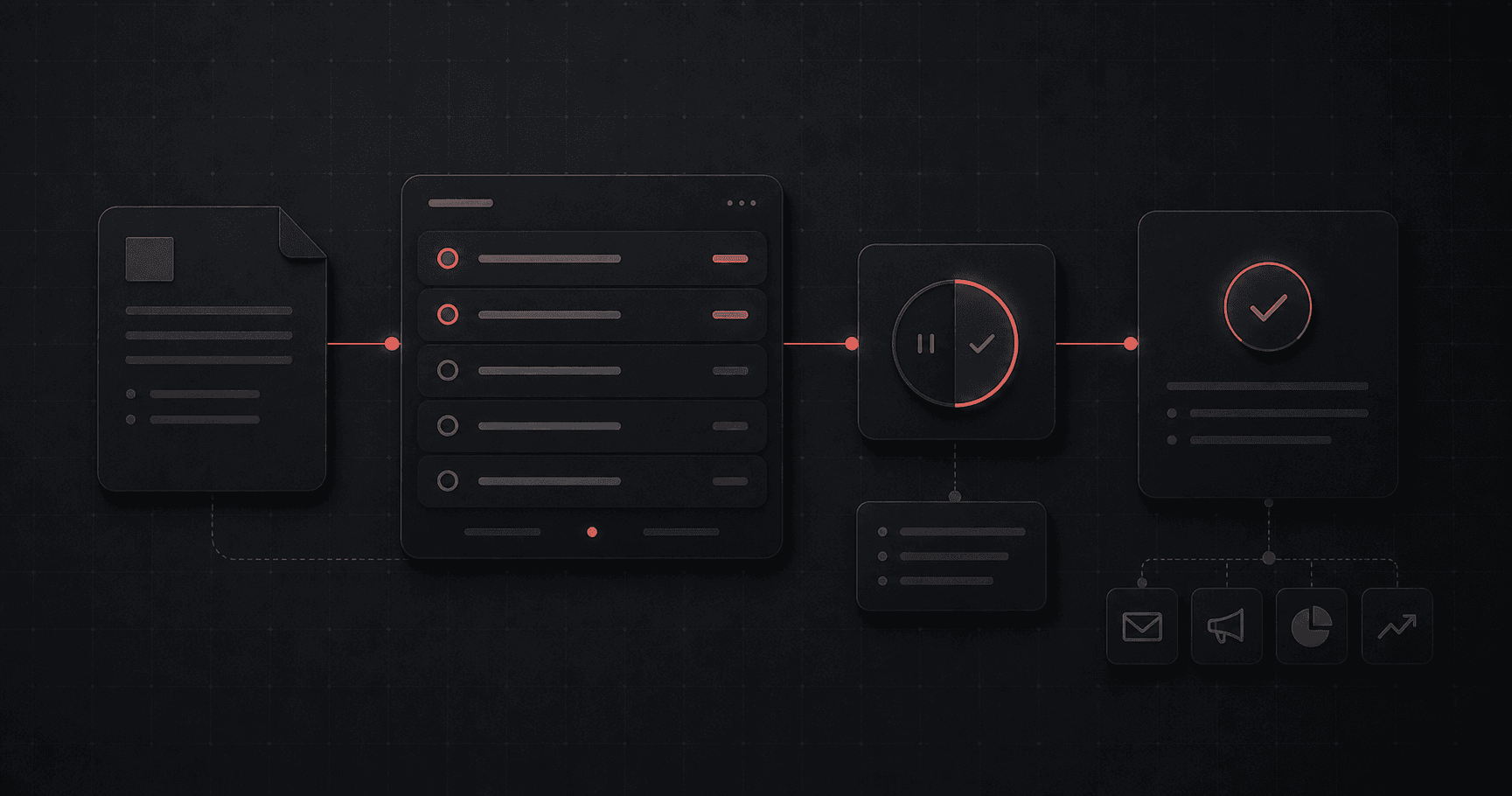
For small SaaS teams, a practical review model is:
- Agent gathers inputs.
- Agent drafts or prepares an operation.
- Human reviews for strategy, accuracy, and tone.
- Agent executes the approved task through a defined tool.
- System records the action.
This is slower than full automation, but much safer. It also creates a learning loop. Over time, you can automate low-risk steps and keep review for high-risk decisions.
Key Takeaways
AI agents are strongest in SaaS marketing operations when tasks are bounded, source-guided, and tool-based.
Do not ask agents to invent your strategy. Ask them to help operate a strategy you have already made explicit.
The best small teams will not automate marketing taste. They will automate repeatable work around positioning, content, partner workflows, reporting, and distribution.